

- /
What Sellers in Northville, Novi, and South Lyon Need to Know Before Listing in 2026

What Homeowners in Northville, Novi, South Lyon, and Plymouth Should Know Before Selling in 2026
If you are thinking about selling your home this year, the most important thing to understand is this: the market has changed, and the strategies that worked in 2021 and 2022 will not serve you well today.
That does not mean it is a difficult market to sell in. It means it is a market where preparation, honest pricing, and smart presentation matter more than they did when every home drew 10 offers in a weekend. Sellers who understand that are doing well. Sellers who are still operating on outdated assumptions are sitting on the market longer than they need to.
Here is what you should know before you decide to list.
The Market Is Balanced, And That Is Actually Good News
Metro Detroit is not in a buyer's market. It is not in the frenzied seller's market of a few years ago, either. What we have right now is a more stable, more predictable environment where well-priced homes in good condition are still selling with strong results.
Northville and Plymouth continue to draw consistent demand, driven by school districts, walkability, and the overall quality of life those communities offer. Novi attracts professionals and buyers looking at newer construction and proximity to major employers. South Lyon is seeing growing interest from buyers seeking more space and a suburban feel at a price point that still makes sense given the broader affordability picture.
Each of these markets has its own rhythm. What is happening in one neighborhood does not always reflect what is happening two miles away. That is why working with someone who knows this specific area, not just Metro Detroit in general, matters when it comes to setting expectations and making decisions.
Pricing Is the Single Most Important Decision You Will Make
Everything else — marketing, staging, timing — supports the price. If the price is wrong, none of it matters.
The mistake many sellers make is treating the initial list price as a starting point for negotiation, assuming they can always come down on it. Buyers do not see it that way. When a home is priced above market, buyers who would otherwise be interested skip it or assume something is wrong. The listing accumulates days on market. The longer it sits, the more buyers wonder what the problem is, even if there is no problem at all.
The data is consistent on this: homes that are priced correctly from the beginning sell faster and typically net more than homes that start high and chase the market down through price reductions.
That does not mean leaving money on the table. It means understanding what buyers in your price range are actually willing to pay right now, based on what has closed recently in your area, and positioning your home accordingly.
Today's Buyers Are More Informed Than Any Previous Generation
Buyers in 2026 are doing extensive research before they ever set foot in a home. They are tracking comparable sales, monitoring days on market, watching price history, and comparing your home against every other option available to them — often before they have even spoken to an agent.
That level of information changes the dynamic. Emotional decisions still happen, but only for homes that genuinely warrant them. If your price does not align with what the data supports, buyers know. And they move on.
This is also why online presentations matter as much as they do. The first showing is almost always on a screen. Professional photography is no longer optional; it is table stakes. A home that does not photograph well simply does not generate the showing traffic needed to produce competitive offers.
Mortgage Rates Have Reshaped Buyer Budgets
Rates are not at the historic lows buyers enjoyed in 2020 and 2021, and that has had a real effect on purchasing power. A buyer who qualified for a $500,000 home a few years ago may be shopping for a $425,000 home today for the same monthly payment.
That does not mean buyers are not out there; they are. But they are more deliberate, they are taking longer to make decisions, and they are less likely to stretch beyond what the numbers support. For sellers, this means pricing needs to reflect where buyers actually are, not where the market was two or three years ago.
Inventory Levels Vary by Area and Price Point
One of the most important things to understand before listing is what the competition looks like in your specific price range and neighborhood. In some segments, inventory remains relatively tight, which favors sellers. In others, there are enough options that a buyer who is not impressed with your home will simply move on to the next.
A comparative market analysis will show you exactly where you stand, how many homes are competing for the same buyer pool, how quickly they are moving, and what the pricing spread looks like. That information should drive your strategy before you ever put a sign in the yard.
Timing Helps, But Pricing Wins
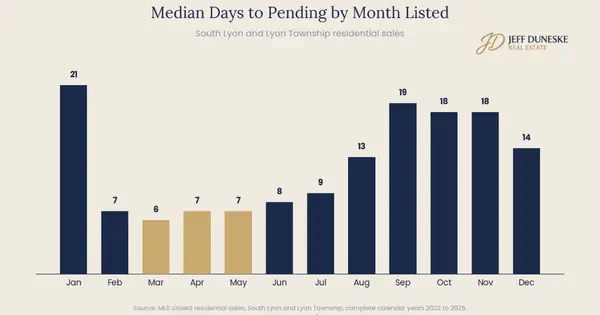
Spring remains the most active season in Michigan real estate. More buyers are looking, more homes come to market, and the combination of daylight and curb appeal works in sellers' favor. If you are planning to sell and have flexibility on timing, spring is generally a stronger window than late fall or winter.
That said, timing is secondary to pricing. A well-priced home sells in January. An overpriced home sits in April. Do not hold off on a sale that makes sense for your life because of a calendar calculation; focus your energy on the things that actually determine the outcome.
Preparing Your Home: Focus on What Buyers Notice
You do not need to renovate your home to sell it well. You need to present it honestly and in its best possible condition.
The improvements that consistently deliver a return are the ones buyers notice in the first five minutes: clean, decluttered spaces; fresh neutral paint; good lighting; and strong curb appeal. Kitchens and bathrooms matter, not because you need to gut them, but because buyers are closely scrutinizing their condition and functionality. Clean, well-maintained flooring reads as a well-maintained home. Worn or damaged flooring raises questions.
Avoid over-improving. Putting significant money into upgrades you cannot recoup at the price point you are selling is one of the most common and costly mistakes sellers make. A conversation with your agent before you spend anything is worth the time.
Marketing Needs to Reach Buyers Where They Are
Strong marketing in 2026 means a strong digital presence. Buyers are finding homes through online search, social media, and direct outreach from agents who are actively working with buyers in your price range.
Professional photography, video walkthroughs, and targeted digital promotion are the foundation. Beyond that, the agent's network matters. A well-connected local agent can generate interest before a home ever hits the MLS, and that early momentum can make a real difference in how a listing launches.
Common Mistakes Worth Avoiding
Pricing based on what you need rather than what the market supports. Your mortgage payoff, your next purchase, your renovation costs, none of that is visible to buyers. They are evaluating your home against the alternatives available to them right now.
Letting emotion drive the decision. This is your home, and it has real meaning. But buyers are evaluating it as a purchase. The sooner you can separate the emotional value from the market value, the clearer your decision-making will be.
Waiting for the perfect market. There is no perfect market. There is the market you are in, and there is a strategy that works within it.
Frequently Asked Questions
Is it a good time to sell in Northville, Novi, South Lyon, or Plymouth? For well-priced, well-presented homes, yes. Demand in these communities remains steady, and qualified buyers are active.
How do I determine the right listing price? Through a comparative market analysis, a review of recent closed sales, current competition, and active buyer demand in your specific price range and neighborhood.
Are buyers still making competitive offers? Yes, on homes that are priced correctly. Overpriced homes are being passed over rather than negotiated down.
Should I renovate before listing? Focus on condition and presentation rather than major renovation. High-impact, cost-effective improvements are worth considering. Significant upgrades rarely return their full cost at sale.
How long should I expect my home to be on the market? A well-priced home in good condition in these communities is typically under contract within two to four weeks. Homes that sit longer are almost always a pricing issue.
Does timing matter? Spring is the strongest season, but pricing matters far more than timing. A correctly priced home sells in any season.
The Bottom Line
Selling successfully in today's Metro Detroit market is not complicated, but it does require honest information and a clear-eyed strategy. The sellers who do well are the ones who understand what buyers are actually looking for, price accordingly, and present their homes in a way that reflects their value.
If you are considering selling in Northville, Novi, South Lyon, Plymouth, or the surrounding area and want an honest conversation about your home's value in today's market, reach out. No pressure. Just clarity.
Categories
- All Blogs (184)
- Best Agent For… Blog Series - Northville, Novi, South Lyon & Metro Detroit (41)
- Brighton Real Estate Market Updates (3)
- Buyers (23)
- Community & Local Events (2)
- Divorce Real Estate (11)
- Estate Planning & Strategy (7)
- Golf Course & Luxury Living (6)
- Green Oak Real Estate Market Updates (2)
- Homeowners (Maintenance & Equity) (2)
- Investors (1)
- Market Conditions (11)
- Metro Detroit Real Estate Updates (32)
- Mortgage & Financing (2)
- New Construction (3)
- Northville Real Estate Market Updates (14)
- Novi Real Estate Market Updates (17)
- Pricing & Home Values (5)
- Relocation & Moving (7)
- Rightsizing & Senior Moves (9)
- Seller Success Stories (10)
- Sellers (59)
- South Lyon Real Estate Market Updates (17)
- Tips, Guides & How-To (10)
Recent Posts


GET MORE INFORMATION