

- /
The Highest Offer Is Not Always the Best Offer: Why My South Lyon Sellers Chose Cash
The highest offer on this South Lyon home wasn't the one my sellers accepted. They chose $718,000 in cash over a financed offer that could have reached $727,800.
That can sound like money left on the table. It was not. The price on an offer is a promise, not a result. What matters is how much of that promise actually makes it to the closing table, and when. Here is how this sale in Carriage Trace came together.
What happened
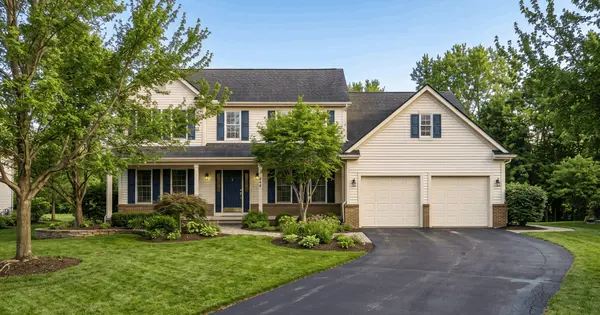
The home was a four-bedroom colonial on a half-acre cul-de-sac lot with a fully finished lower level. We listed it at $699,900. It went active on a Thursday, and we set an offer deadline for 5 PM the following day.
By the deadline, there were three offers. All three waived the inspection. All three gave the sellers 60 days in the home after closing, which mattered to them. On the surface, it looked like an easy decision. It was not.
How did the three offers compare?
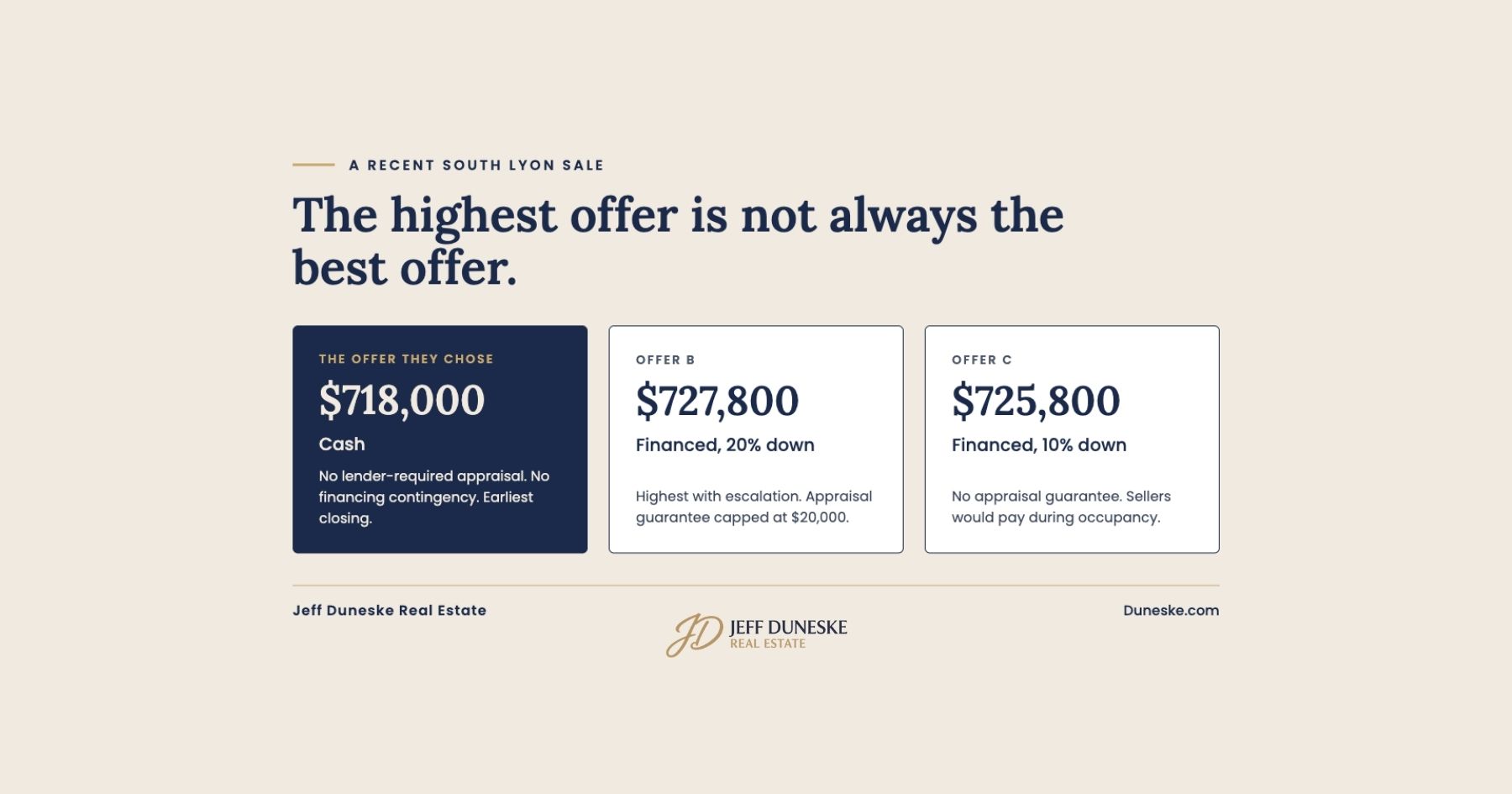
| Offer A | Offer B | Offer C | |
|---|---|---|---|
| Price | $718,000 | $720,000 | $725,800 |
| Financing | Cash | Conventional, 20% down | Conventional, 10% down |
| Appraisal guarantee | Not needed | Up to $20,000 | None |
| Escalation clause | No | $2,000 over competing offers, up to $750,000 | No |
| Earnest money | $5,000 | $15,000 | $10,000 |
| Closing date | July 24 | July 29 | July 31 |
| Occupancy after closing | 60 days, no charge | 60 days, no charge | 60 days, sellers pay the buyer's monthly payment |
Because of its escalation clause, Offer B could have reached $727,800, which is $2,000 above Offer C. So the real question became simple. Should the sellers take $718,000 in cash, or as much as $727,800 with a loan?
They chose the cash offer. Here is why that can be the stronger decision.
Why would a seller choose a lower cash offer?
The appraisal gap
When a buyer uses a mortgage, the lender orders an appraisal. If the appraisal comes in below the contract price, the lender will only lend based on the appraised value. Someone has to cover the difference, or the deal gets renegotiated.
At $727,800, Offer B was about $28,000 above the list price. Its appraisal guarantee covered up to $20,000. That means any appraisal below $707,800 would have reopened the negotiation. Offer C had no appraisal guarantee at all, so any appraisal below $725,800 would have done the same.
For a seller, a low appraisal leads to one of three outcomes. The buyer brings more cash to cover the gap, the price gets renegotiated downward, or, depending on the contract, the deal falls apart and the home goes back on the market. None of those outcomes are known on the day you accept the offer.
In a competitive multiple-offer situation, the contract price can move ahead of the recent comparable sales an appraiser has available. That can create additional risk when a buyer is financing the purchase. With this cash offer, there was no lender-required appraisal and no appraisal contingency, so that particular risk was removed.
Financing risk
A strong preapproval is not a final loan approval. Underwriting can turn up issues with a buyer's income, credit, or debt late in the process. With cash, there is no loan to fall through.
Time and occupancy
The cash offer had the earliest closing date. It also gave the sellers 60 days in the home after closing at no cost, with the option to stay a little longer if they needed. Offer C also offered 60 days, but the sellers would have paid the buyer's monthly mortgage payment, taxes, and insurance during that time. Over two months, that cost alone takes a meaningful bite out of a higher price.
The real difference
Once you account for appraisal risk and occupancy costs, the $9,800 gap between the cash offer and the escalated Offer B was smaller than it looked, and far less certain. The sellers were trading a possible higher number for a near-certain one.
That does not mean cash always wins. A financed offer with a meaningfully higher price, solid appraisal protection, a well-qualified buyer, and workable timing can absolutely be the better choice. The lesson is not cash versus financing. It is comparing the whole offer, not just the top line.
The home closed on July 24 at $718,000, which is 102.6% of the list price.
How do I help sellers compare offers?
When multiple offers arrive, I prepare a side-by-side summary for my sellers, much like the table above. We go through it together, line by line. I look at estimated net proceeds, the strength of each buyer's financing, appraisal exposure, contingencies, closing dates, and occupancy terms.
Then I ask what matters most to them. For some sellers, it is the highest possible price. For others, it is certainty, timing, or time to move. In this case, the sellers told me early on that time after closing was important. That shaped which offer was truly best for them.
My job is not to choose for you. It is to make sure you understand what each offer actually means, so the decision you make is one you are comfortable with long after closing. You can read more about how I approach selling a home.
Thinking about selling in South Lyon?
If you are thinking about selling a home in South Lyon, Lyon Township, or New Hudson, I can help you understand not only what your home may sell for, but also how I would evaluate the terms, risks, and timing of an offer in today's market. I have been helping homeowners here since 2000, and I am happy to talk it through.
Call or text me at (248) 939-9393.
No pressure. Just clarity.
Categories
- All Blogs (190)
- Best Agent For… Blog Series - Northville, Novi, South Lyon & Metro Detroit (41)
- Brighton Real Estate Market Updates (3)
- Buyers (23)
- Community & Local Events (2)
- Divorce Real Estate (11)
- Estate Planning & Strategy (7)
- Golf Course & Luxury Living (6)
- Green Oak Real Estate Market Updates (2)
- Homeowners (Maintenance & Equity) (2)
- Investors (1)
- Market Conditions (12)
- Metro Detroit Real Estate Updates (34)
- Mortgage & Financing (2)
- New Construction (3)
- Northville Real Estate Market Updates (14)
- Novi Real Estate Market Updates (17)
- Pricing & Home Values (7)
- Relocation & Moving (7)
- Rightsizing & Senior Moves (10)
- Seller Success Stories (11)
- Sellers (64)
- South Lyon Real Estate Market Updates (18)
- Tips, Guides & How-To (11)
Recent Posts





GET MORE INFORMATION