

- /
Selling a Home in Northville, Novi, or South Lyon? Why the First 10 Days Matter.
By Jeff Duneske, Associate Broker | October 21, 2026
If your home has been on the market for a week or two without an offer, it is natural to wonder whether something is wrong. Local sales data gives a clear answer about what early market time tends to mean, and an equally clear answer about what it does not mean.
I reviewed 1,185 resale home sales that closed from January 1 through October 20, 2026, across Northville, Novi, South Lyon, Lyon Township, Brighton, and Green Oak Township. About four in five homes that sold within 10 cumulative days on market achieved or exceeded their first asking price. Among homes that took longer, about one in five did.
That does not mean a home loses value on day 11. It means the first two weeks are when buyer response to a price is usually clearest. The lesson for sellers is not to price low. It is to price carefully, launch prepared, and treat early buyer activity as useful information.
What Does the Local Sales Data Show?
The longer a home took to sell, the less likely it was to reach its first asking price, and the further below that price it tended to close.
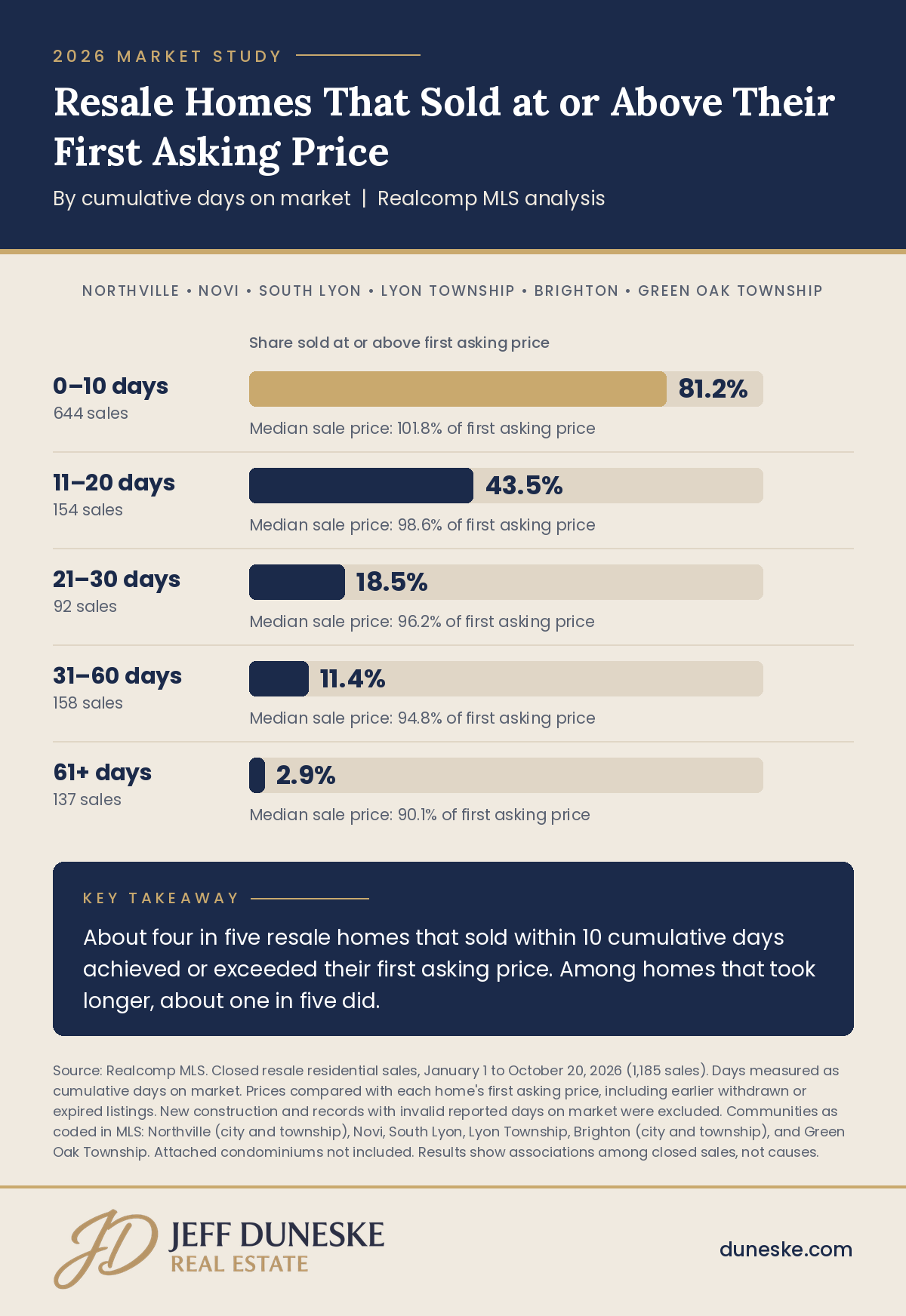
Among homes that sold within 10 cumulative days, about 81 percent sold at or above their first asking price. That share fell to about 44 percent for homes that sold in 11 to 20 days, about 19 percent at 21 to 30 days, and about 11 percent at 31 to 60 days. Beyond 60 days, only about 3 percent reached their first asking price.
The size of the gap matters as much as the percentages. Homes that sold within 10 days typically closed slightly above their first asking price, at a median of about 102 percent. Homes that took more than 60 days typically closed about 10 percent below it. For illustration, a home first listed at $600,000 that followed the typical pattern of the slowest group would have sold for about $540,000.
These figures describe homes that eventually closed. They are not a forecast for any individual listing. Price, condition, location, and competition affect both how quickly a home sells and what it sells for, so the data shows a strong association rather than proof that time on the market causes a lower price.
Why Does Cumulative Days on Market Matter?
Cumulative days on market measures a property's total reported market exposure, including qualifying previous listing periods, rather than relying solely on the most recent listing. To keep the price comparison consistent, each sale was also compared with the home's first asking price from any earlier withdrawn or expired listing.
This matters because a withdrawn and relisted home can look like a quick, full-price sale when it was nothing of the kind. In one Northville Township sale in the data, a home first listed at $590,000 was withdrawn and relisted at $525,000. It sold at that price four days into the new listing. Viewed in isolation, the newer listing appears to show a fast, full-price sale. The full history shows 86 days of market exposure and a sale about 11 percent below the original asking price.
More than 100 homes in the study had an earlier withdrawn or expired listing. Counting their full history makes the results more conservative and, I believe, more honest.
Why Are the First 10 Days So Important?
When a home first comes on the market, it reaches buyers and agents who may have been waiting for a property with its features, location, and price. Many of those buyers have already toured the competition and understand what is available.
A well-positioned home can earn real attention during that first exposure. A new listing does not automatically create urgency, though. If buyers see better value elsewhere, they will often tour those homes first.
Market time is information, not a verdict. After more than 26 years working in this market, I have found that one of the most important parts of selling a home is reading buyer activity accurately rather than reacting to it emotionally. A home with very few showings has a different problem from a home with many showings and no offers, and the two call for different conversations.
Does a Home Need a Price Reduction After 10 Days?
No. Ten days should be a review point, not an automatic deadline for a price reduction.
The right question is not simply how long the home has been listed. It is what the market is telling you about the home at its current price.
When I review a listing, I look at whether qualified buyers are scheduling showings and what buyers and their agents are saying about price, condition, and layout. I also watch whether comparable homes have come on the market, reduced their prices, or gone under contract, and whether online interest is turning into actual showings. Finally, I compare the listing with how long genuinely similar homes are taking to find buyers.
A reduction may be appropriate when the evidence consistently points to price. Lowering the price only because a set number of days has passed is not a strategy I recommend.
How Often Did Local Sellers Reduce Their Asking Price?
About one in four resale homes in the study had a final asking price below their first asking price. Among those homes, the median reduction was about 5 percent. On a $600,000 first asking price, that is roughly $30,000.
Two qualifications apply. This figure compares the first and final asking prices, so it does not capture each step in between or when each change happened. It also includes only homes that closed, so it should not be read as the share of all listings that needed a reduction.
What it does show is that a meaningful share of completed sales involved sellers revising their original pricing. The goal is to reduce the chance of an unnecessary adjustment through careful preparation and pricing before the home reaches the market.
Does the Pattern Change by Price Range?
The pattern held across every price range with enough sales to measure. Homes under $600,000 and homes between $600,000 and $1 million both showed roughly four in five fast sales reaching their first asking price, compared with about one in five of the slower sales.
Homes between $1 million and $1.5 million followed the same general pattern, although that group is smaller. They also did not take longer to sell. About two-thirds of those homes sold within 10 cumulative days, compared with about half of homes under $600,000. There were too few sales above $1.5 million to draw a reliable conclusion.
Higher-priced homes are sometimes assumed to need more time on the market. In these communities during this period, that assumption was not supported by the data.
Should You Price Below Market Value to Sell Quickly?
Not necessarily. Pricing competitively and deliberately underpricing a home are not the same thing.
A sound first asking price reflects recent comparable sales, active competition, condition, updates, location, and the buyers most likely to consider the home.
Consider two hypothetical homes with similar market values. One is introduced at a price supported by its competition. The other starts well above that level to leave room for negotiation. The second home may still sell well, but it can also miss buyers whose search limits fall below its price or whose expectations are shaped by the homes around it. If its price is reduced later, it competes as an established listing rather than a new one.
That is why I treat price as part of the full marketing plan rather than a number chosen in isolation. Photography, presentation, condition, showing access, and a thoughtful launch all shape how buyers see a home. A good list price supports those efforts. It cannot replace them.
What If Your Home Has Been Listed for More Than 10 Days?
First, do not assume the listing has failed. Hundreds of homes in this study sold after their first 10 days.
The next step is to review the evidence. With few showings, the conversation should focus on whether the home is reaching the right buyers and offering competitive value. With plenty of showings but no offers, the feedback and the competing homes deserve a closer look. When an offer is on the table but negotiations are difficult, financing, inspection terms, appraisal risk, concessions, and closing flexibility can matter as much as price.
Sometimes the right move is a price adjustment. Other times it is improving presentation, addressing a condition issue, or simply allowing more time. The key is to decide using current information rather than hoping the market changes on its own.
What Does This Mean for Buyers?
Longer market time can create room to negotiate, but it does not automatically mean a home is overpriced. A home listed for several weeks may offer more flexibility than a new listing drawing multiple offers. Its seller may also have already reduced the price to a level supported by recent sales.
Before deciding what to offer, look at the home's competition, first asking price, price history, condition, and recent comparable sales. An offer 5 percent below asking can be reasonable on one home and unrealistic on another.
Frequently Asked Questions
Why were new construction homes excluded?
Builder listings often show a base price, and buyers add options and upgrades before closing. That can make a slow-selling new home appear to sell well above its asking price, which would distort a comparison meant for homeowners selling an existing home.
Were condominiums included?
Attached condominiums were not included. Detached homes in site condominium developments, which are common in these communities, were included because they are classified as residential properties in the MLS.
Does a quick sale mean a home was underpriced?
Not necessarily. Homes that sold within 10 cumulative days closed at a median of about 102 percent of their first asking price, which suggests most were priced close to what buyers were willing to pay. The data cannot show whether any individual home could have sold for more.
What This Means for Your Local Market
The best pricing decision depends on the home and its direct competition. A Northville Township property and a Lyon Township property may face different buyers, inventory, and expectations even when their asking prices are similar. These regional findings are a starting point, not a substitute for reviewing comparable sales and current listings in your specific market.
Talk Through Your Pricing Strategy
If you are thinking about selling in Northville, Novi, South Lyon, Lyon Township, Brighton, or Green Oak Township, I would be glad to show you how homes like yours have been performing and what a sensible pricing strategy could look like for your situation, whether you sell now, later, or not at all.
You can also read what to expect when selling your home with Jeff Duneske or send Jeff a question directly.
No pressure. Just clarity.
About the Author
Jeff Duneske is an Associate Broker with Keller Williams Advantage and leads Jeff Duneske Real Estate in downtown Northville. With more than 26 years of experience and more than 1,300 homes sold, he helps homeowners and buyers in Northville, Novi, South Lyon, Lyon Township, Brighton, and Green Oak Township make confident real estate decisions. He has earned more than 450 verified five-star reviews.
About This Market Study
Source: Realcomp MLS exports analyzed by Jeff Duneske Real Estate.
Reporting period: Sales that closed January 1 through October 20, 2026, the latest closing date in the data.
Geography: Communities as coded in the MLS: Northville (city and township), Novi, South Lyon, Lyon Township, Brighton (city and township), and Green Oak Township. A small number of records carried neighboring mailing-address labels and were kept as coded.
Property type: Residential property type, resale homes only. Attached condominiums are classified separately in the MLS and were not included.
Sample: 1,248 closed residential sales. Sixty homes built in 2025 or 2026 were excluded as new construction, and three records with invalid reported days on market were excluded, leaving 1,185 resale sales.
Method: Each sale was grouped by its reported cumulative days on market. Sale prices were compared with each home's first asking price. For 105 homes, that first asking price came from an earlier withdrawn or expired listing of the same property, matched by parcel number or address. Of the 644 homes that sold within 10 cumulative days, 523 (81.2 percent) sold at or above their first asking price. Of the 541 homes that sold after 10 days, 106 (19.6 percent) did. Of all 1,185 sales, 313 (26.4 percent) had a final asking price below their first asking price, with a median reduction of 5.1 percent.
Limitations: Results reflect closed sales only, not every listing attempt. Homes that were withdrawn or expired and never sold are not included. Prior listings were matched only where they appeared in the available MLS data, so some earlier listing history may be missing, which would make the slower groups look somewhat better than they were. The statistics show associations, not proof that longer market time caused lower prices. Results may differ by community, property type, and price range.
Categories
- All Blogs (193)
- Best Agent For… Blog Series - Northville, Novi, South Lyon & Metro Detroit (41)
- Brighton Real Estate Market Updates (3)
- Buyers (23)
- Community & Local Events (2)
- Divorce Real Estate (11)
- Estate Planning & Strategy (7)
- Golf Course & Luxury Living (6)
- Green Oak Real Estate Market Updates (2)
- Homeowners (Maintenance & Equity) (2)
- Investors (1)
- Market Conditions (13)
- Metro Detroit Real Estate Updates (35)
- Mortgage & Financing (2)
- New Construction (3)
- Northville Real Estate Market Updates (14)
- Novi Real Estate Market Updates (17)
- Pricing & Home Values (7)
- Relocation & Moving (7)
- Rightsizing & Senior Moves (10)
- Seller Success Stories (12)
- Sellers (65)
- South Lyon Real Estate Market Updates (18)
- Tips, Guides & How-To (11)
Recent Posts



GET MORE INFORMATION