

- /
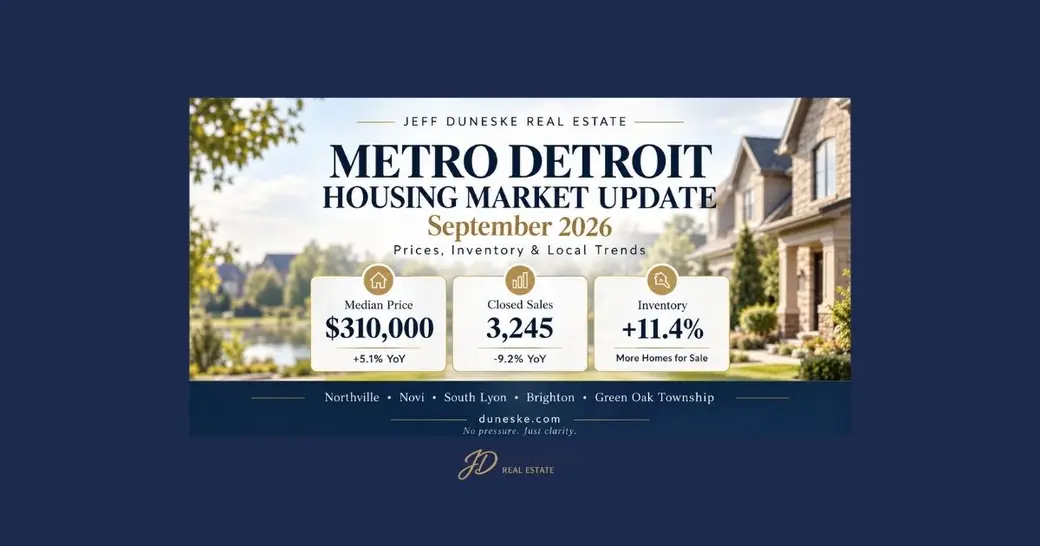
Metro Detroit Housing Market Update: September 2026
Metro Detroit Housing Market Update: September 2026
Home prices remain higher than a year ago, but fewer homes are selling and buyers have more choices. Here's what the latest numbers mean in Northville, Novi, South Lyon, Brighton and Green Oak Township.
The Big Picture: Higher Prices, Slower Sales
As we enter the final quarter of 2026, Metro Detroit's housing market isn't moving in one simple direction. Prices are still rising compared with last year, but sales activity has slowed and the number of homes available has grown.
Pending sales fell 12.3% from September 2025, while the region had 3.2 months of residential inventory, up from 2.9 months a year ago. Homes that closed averaged 28 days on market, unchanged from September 2025. Buyers received more choices overall, but that doesn't necessarily mean every listing is negotiable.
September Home Prices Across Our Communities
The residential median prices below describe the homes that closed during September, not the appreciation or depreciation of any individual property.
| Market | Sept. 2026 median | Change vs. Sept. 2025 | Closed sales |
|---|---|---|---|
| Northville | $775,000 | +22.0% | 11 |
| Northville Township | $791,000 | −18.0% | 18 |
| Novi | $631,525 | +15.3% | 34 |
| South Lyon | $375,000 | −36.4% | 9 |
| Lyon Township | $625,000 | +18.1% | 33 |
| Brighton City | $469,500 | −1.2% | 7 |
| Brighton Township | $548,950 | −3.0% | 24 |
| Green Oak Township | $451,000 | −3.5% | 14 |
| Metro Detroit | $310,000 | +5.1% | 3,245 |
Source: Realcomp II Ltd., September 2026 Local Market Update reports. Metro Detroit covers Livingston, Macomb, Oakland and Wayne counties.
What September Means in Your Local Market
Northville and Northville Township
Northville City posted a $775,000 September median, up 22.0%, while Northville Township's $791,000 median was down 18.0%. Both monthly samples were small: 11 city closings and 18 township closings. Year to date, the city median was $637,500 (down 6.9%) and the township median was $817,500 (down 0.9%). The takeaway isn't that one area suddenly gained value while the other lost it; it is that the mix of properties sold differs. A specific home still needs carefully selected comparable sales.
See the detailed Northville real estate market report →Novi
Novi's residential market held up well in September: a $631,525 median sale price, up 15.3%, with 34 closed sales, up 13.3%. Homes averaged 19 days on market. Yet inventory rose 27.6% to 74 homes, so sellers have more direct competition than a year ago. The January–September median of $600,000 was up a more measured 3.4%. That broader view is useful when evaluating pricing.
See the detailed Novi real estate market report →South Lyon and Lyon Township
These are two distinct markets. The City of South Lyon had nine residential closings and a $375,000 September median, down 36.4% year over year. Lyon Township had 33 closings and a $625,000 median, up 18.1%. Year to date, their medians were $445,000 and $645,000 respectively. Differences in housing stock, neighborhood and what happened to close each month make it especially important not to combine the municipalities or take monthly changes as home-value estimates.
See the detailed South Lyon and Lyon Township market report →Brighton City and Brighton Township
Brighton City recorded only seven residential closings in September, with a $469,500 median and 1.1 months of inventory. Brighton Township had 24 closings, a $548,950 median and 3.2 months of inventory. Those supply differences matter when thinking about competing listings. The township's closed homes averaged just 12 days on market, compared with 40 days in the city, but small monthly groups can produce sharp variations.
See the detailed Brighton real estate market report →Green Oak Township
Green Oak Township had 14 residential closings in September, a $451,000 median and 12 average days on market for completed sales. Inventory increased 59.4% year over year to 51 available homes. That combination shows why more available listings does not automatically mean slow sales for every property. The year-to-date median was $469,900, down 6.3%, and should be read alongside relevant comparables.
See the detailed Green Oak Township real estate market report →Condo Buyers Have More Options in Many Areas
Condominiums deserve a separate conversation from detached residential homes. Across Metro Detroit, condo inventory increased 29.7% from a year earlier to 2,463 units, with 3.9 months of supply. The September median condo price was $265,000, up 1.9%, while completed condo sales averaged 38 days on market, compared with 30 days a year earlier.
Novi's condo inventory increased 76.7% to 76 units, representing 3.7 months of supply. Brighton Township recorded 8.0 months of condo supply, though its September closing sample was only five. In Northville, only nine city condos closed in September; the city median was $700,000, so it would be misleading to present its 72.2% year-over-year monthly median increase as broad condo appreciation.
For anyone downsizing or comparing condo communities, I would examine the particular development, unit style, HOA obligations, maintenance responsibilities and competing listings—not just the citywide condo median.
Should You Sell in Late 2026 or Wait Until Spring 2027?
There isn't one answer for everyone. September's data doesn't prove that waiting until spring will produce a higher price, nor does it suggest that every homeowner should rush to list this fall.
What matters is your situation: the home you're selling, the price range, how much competing inventory is available, whether you need to buy another property and the preparation required before putting your home on the market.
Price Against Today's Competition
Review recently sold comparable homes, current active listings, price reductions and known pending activity. The best pricing strategy starts with the market the property actually competes in.
Prepare With a Purpose
Prioritize improvements that help buyers understand the home's condition and value. Not every project is worth completing before a sale.
If your timeline is flexible, evaluating the market now can still be useful. It gives you time to decide on preparation and pricing before choosing when to list.
More Inventory Doesn't Mean Every Home Is a Bargain
Buyers have more choices across Metro Detroit than they had last September, but some well-presented properties are still selling quickly. A home that's new to the market, priced well and attracting significant activity calls for a different approach from a listing that has been sitting for weeks.
I recommend reviewing the property's recent comparable sales, condition, time on market, seller's terms and current alternatives before deciding what to offer. For condos, review association documents and costs as part of the decision, too.
What I'll Be Watching in the Fourth Quarter
I've worked in Metro Detroit real estate since 2000, and one thing that continues to hold true is that broad market headlines seldom tell the whole story. September's numbers are a reminder of that.
As we move toward the end of 2026, I'll be watching whether new listings continue to outpace buyer demand, how long homes take to sell at different price points, and whether the increase in inventory translates into more negotiation on the properties buyers are actually considering.
For homeowners, these reports are helpful context—not a substitute for an evaluation of your specific home. If you're planning a move, downsizing, or simply wondering what your property might sell for, I'm happy to help you work through the numbers and your options.
No pressure. Just clarity.
What Does This Market Mean for Your Home?
Let's look at your property's recent comparable sales, current competition and your timing so you can make a well-informed decision.
Jeff Duneske
Associate Broker | Jeff Duneske Real Estate
Keller Williams Advantage
Data source: Realcomp II Ltd., September 2026 Local Market Update reports, current as of October 7, 2026. Metro Detroit covers Livingston, Macomb, Oakland and Wayne counties. Realcomp sale-price and list-price-received statistics do not account for sale concessions or down-payment assistance. Monthly and year-to-date median changes reflect different sets of homes sold, not repeat-sale appreciation of individual homes.
Categories
- All Blogs (191)
- Best Agent For… Blog Series - Northville, Novi, South Lyon & Metro Detroit (41)
- Brighton Real Estate Market Updates (3)
- Buyers (23)
- Community & Local Events (2)
- Divorce Real Estate (11)
- Estate Planning & Strategy (7)
- Golf Course & Luxury Living (6)
- Green Oak Real Estate Market Updates (2)
- Homeowners (Maintenance & Equity) (2)
- Investors (1)
- Market Conditions (12)
- Metro Detroit Real Estate Updates (35)
- Mortgage & Financing (2)
- New Construction (3)
- Northville Real Estate Market Updates (14)
- Novi Real Estate Market Updates (17)
- Pricing & Home Values (7)
- Relocation & Moving (7)
- Rightsizing & Senior Moves (10)
- Seller Success Stories (11)
- Sellers (64)
- South Lyon Real Estate Market Updates (18)
- Tips, Guides & How-To (11)
Recent Posts





GET MORE INFORMATION