

- /
What Does It Really Cost to Sell Your Home in Michigan?
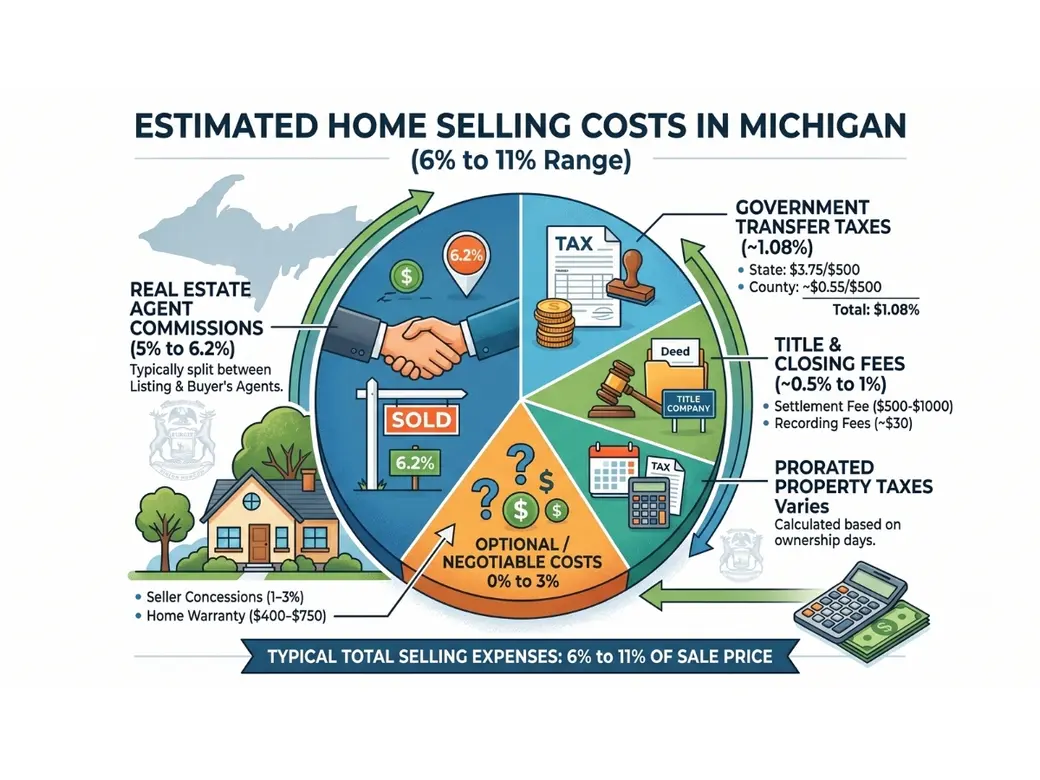
What Does It Really Cost to Sell Your Home in Michigan?
Most sellers do not think about costs until they are sitting at a closing table. By then, it is too late to plan. Understanding what you will pay, and why, before you list puts you in a much stronger position to make smart decisions about timing, pricing, and net proceeds.
This is not a scare article. Most sellers in Metro Detroit walk away with strong equity. But the clearer your picture going in, the fewer surprises you face on the way out.
Real Estate Commission
Commission is typically the largest single cost in a home sale. Traditionally, sellers paid a combined commission that covered both the listing agent and the buyer's agent. That structure has shifted. As of 2024, commission arrangements are now negotiated separately, and buyers and their agents determine their own compensation agreements.
What this means for you as a seller is that your listing fee is now its own conversation. The rate varies by agent, service level, and what is included. What should not vary is what you receive in return: full-service marketing, professional photography, strategic pricing, skilled negotiation, and an experienced advocate protecting your net proceeds from offer to close.
When evaluating commission, the right question is not who charges the least. The right question is who puts the most money in your pocket after everything is said and done.
Michigan Transfer Tax
Michigan sellers pay a state transfer tax when ownership of a home changes hands. The rate is $3.75 per $500 of the sale price, or 0.75 percent of the sale price. There is also a county transfer tax, which varies slightly by county but typically adds another $1.10 per $500, or roughly 0.22 percent.
On a $400,000 sale, combined transfer taxes run approximately $3,880. This is a fixed cost that does not go away, though in some circumstances sellers who are selling at a loss relative to their original purchase price may qualify for a state transfer tax refund. A real estate attorney or tax advisor can tell you whether that applies to your situation.
Title Insurance and Closing Fees
In Michigan, sellers typically pay for the owner's title insurance policy, which protects the buyer against any title defects that originated before or during your ownership. The cost is based on the sale price and usually runs between $1,000 and $2,500 for most homes in the Metro Detroit price range.
Closing fees, escrow fees, and title company charges add additional costs. These vary by title company and transaction complexity, but sellers should generally expect $500 to $1,200 in combined administrative and closing-related fees beyond the title insurance premium itself.
Property Taxes and Prorations
Michigan property taxes are paid in arrears, meaning you pay this year's taxes next year. At closing, sellers credit buyers for the portion of the current year's taxes that has accrued up to the closing date. The exact amount depends on when you close and your specific tax bill, but this is a real cost to plan for. On a $400,000 home in Oakland County or Western Wayne County, the proration can easily run $2,000 to $4,000 depending on time of year and local millage rates.
Repairs, Prep, and Pre-Sale Work
Not every seller needs to spend money before listing. Some homes are ready as-is. Others benefit from targeted updates. The key word is targeted. Replacing a roof because a buyer's inspector flagged it after you are already under contract is almost always more disruptive and expensive than addressing it before listing. A pre-listing inspection can help you identify what matters and what does not.
Common pre-sale expenses include fresh paint, carpet cleaning or replacement, landscaping cleanup, minor repairs flagged by a walk-through, and professional staging or decluttering. Sellers in Novi, South Lyon, Northville, and Brighton typically spend anywhere from nothing to several thousand dollars in this category, depending on the home's condition and the seller's goals.
The goal is not to spend more. The goal is to make smart investments that either hold your price or justify asking more.
Seller Concessions
In some transactions, sellers agree to cover a portion of the buyer's closing costs as part of the negotiation. This is not universal, and it is not required. But it is worth understanding as a potential cost. Concessions are negotiated and depend heavily on market conditions, buyer demand, and how your home is priced.
A well-priced, well-prepared home in a strong market often sees little to no seller concessions. A home that sat too long or received limited interest may face more pressure. Pricing strategy matters here more than most sellers realize.
Mortgage Payoff
If you have a mortgage, the outstanding balance is paid from proceeds at closing. This is not a "cost" in the traditional sense, but it directly affects your net. Request a payoff statement from your lender before you list. The payoff amount is slightly higher than your current balance because it includes interest that will have accrued through the projected closing date.
If you have a home equity line of credit, that balance is also paid off at closing. Both amounts will appear on your closing disclosure before you sign.
What Does This Mean for Your Net Proceeds?
Adding these categories together, most Michigan sellers should expect total selling costs, not counting their mortgage payoff, to fall somewhere between 7 and 10 percent of the sale price. On a $450,000 sale, that range represents roughly $31,500 to $45,000 before the mortgage payoff is calculated.
That may feel like a wide range, and it is. Commission structure, whether you do pre-sale work, your local tax rate, and what you negotiate with a buyer all influence where your number lands. The best way to get a clear picture is to sit down with an experienced listing agent who can walk through a seller's net sheet before you list, not after.
A net sheet is not a guarantee. It is a planning tool. But it gives you a real number to work with, and that changes how you think about timing, your next home, and what you need to walk away with.
Timing Affects Costs Too
Sellers sometimes ask whether spring is cheaper to sell than fall. The season itself does not change your closing costs. But timing affects how quickly you sell and at what price, which indirectly affects everything from whether you make concessions to whether you carry two mortgages temporarily. Selling in a month with strong buyer demand in your area generally reduces the risk of price reductions and extended carrying costs.
If you are not sure whether now is a good time for your specific situation — financially, logistically, or personally — that is a completely reasonable place to be. Staying put, waiting six months, or taking time to prepare can all be the right answer depending on your goals.
A Realistic Look Is the Right Starting Point
None of these costs should be a surprise at the closing table. If you are thinking about selling a home in Novi, South Lyon, Northville, Brighton, or the surrounding Metro Detroit area, getting a clear seller's net sheet early in the process is one of the most practical things you can do.
It costs nothing to have that conversation, and it gives you the information you need to decide whether selling makes sense right now, what price range you need to target, and what steps to take before you list.
If you would like to talk through the numbers for your specific home, reach out here or visit what to expect when selling your home with Jeff Duneske to understand the full process before you make any decisions.
Frequently Asked Questions
What percentage does a seller pay in closing costs in Michigan?
Michigan sellers typically pay between 7 and 10 percent of the sale price in total selling costs, which includes agent commission, state and county transfer taxes, title insurance, prorated property taxes, and closing fees. The exact amount depends on your specific transaction.
Who pays the real estate commission in Michigan?
The seller pays the listing agent's commission directly. Since 2024, buyer's agent compensation is negotiated separately between the buyer and their agent and is no longer automatically included in what the seller pays. Your listing agreement will clearly state your specific commission obligation.
Do sellers pay transfer tax in Michigan?
Yes. Michigan sellers pay a state transfer tax of $3.75 per $500 of the sale price, plus a county transfer tax that typically adds approximately $1.10 per $500. Combined, this is roughly 0.86 percent of the sale price.
What is a seller's net sheet?
A seller's net sheet is an estimate of what you will walk away with after all selling costs and your mortgage payoff are deducted from the sale price. It is a planning document, not a guarantee, but it gives you a clear number to work with before you decide to list.
Can a seller in Michigan get a transfer tax refund?
In some cases, yes. Michigan allows a state transfer tax refund if you sell a home for less than you originally paid for it, subject to certain conditions. This is uncommon in most Metro Detroit markets but worth asking a real estate attorney or tax advisor about if your situation involves a potential loss.
Should I do repairs before selling my home in Michigan?
Not necessarily. Whether pre-sale repairs make sense depends on your home's condition, the price point, and what comparable homes in your area look like. A pre-listing consultation can help you identify what is worth addressing and what is not.
How do prorated property taxes work when selling a home in Michigan?
Because Michigan property taxes are paid in arrears, sellers credit buyers at closing for the portion of the current year's taxes that accrued up through the closing date. The exact amount depends on your local millage rate and when in the year you close.
About Jeff Duneske
Jeff Duneske is an Associate Broker with Keller Williams Advantage, based in downtown Northville, Michigan. With more than 25 years of experience, over 1,300 homes sold, and more than 450 verified five-star reviews across Google, Zillow, Realtor.com, RateMyAgent, and FastExpert, Jeff serves homeowners across Novi, South Lyon, Northville, Brighton, Plymouth, and the greater Metro Detroit area.
Jeff's approach is straightforward: give people honest information, build a clear strategy, and protect their interests from the first conversation through the final signature. No pressure. Just clarity.
Connect with Jeff or learn more at duneske.com.
Categories
- All Blogs (195)
- Best Agent For… Blog Series - Northville, Novi, South Lyon & Metro Detroit (41)
- Brighton Real Estate Market Updates (3)
- Buyers (23)
- Community & Local Events (2)
- Divorce Real Estate (11)
- Estate Planning & Strategy (7)
- Golf Course & Luxury Living (6)
- Green Oak Real Estate Market Updates (2)
- Homeowners (Maintenance & Equity) (2)
- Investors (1)
- Market Conditions (13)
- Metro Detroit Real Estate Updates (35)
- Mortgage & Financing (2)
- New Construction (3)
- Northville Real Estate Market Updates (14)
- Novi Real Estate Market Updates (17)
- Pricing & Home Values (7)
- Relocation & Moving (7)
- Rightsizing & Senior Moves (10)
- Seller Success Stories (14)
- Sellers (67)
- South Lyon Real Estate Market Updates (18)
- Tips, Guides & How-To (13)
Recent Posts







GET MORE INFORMATION