
What Sellers in Northville, Novi, South Lyon, and Plymouth Should Know Before Listing in 2026 — Pricing Strategy, Buyer Behavior, and Local Inventory

Sellers in Northville, Novi, South Lyon, and Plymouth in 2026 are operating in a market that is best described as stable and selective. Inventory has loosened compared with the frenzy years, buyers have regained meaningful leverage, and pricing accuracy matters more now than at any point in the last five years. Northville home values are up roughly 6.5 percent year over year with homes going to pending in about 12 days. South Lyon values are up 4 to 5 percent. Plymouth and Novi continue to command a premium for walkability and schools. The homes that sell quickly and at strong prices are the ones priced correctly from day one, prepared properly before listing, and marketed to a clearly identified buyer profile. The homes that linger almost always trace back to a pricing decision that did not match the market.
What the 2026 Metro Detroit Market Actually Looks Like
The first thing to understand is that the 2026 market is not the 2021 market, and it is not the 2023 market either. It is a third pattern that combines elements of both — and sellers who are operating from the playbook of either of those years will misread the current conditions.
Inventory has improved across Metro Detroit. According to Re/Max of Southeastern Michigan, buyers should expect more choices in 2026 than in recent years as more homeowners — particularly the baby boomer generation — decide to sell. That improvement is real, but it is also modest in the western Oakland and western Wayne County communities. Mortgage rates are projected to hover in the mid-6 percent range nationally and dip to roughly 6.1 percent through 2026, which keeps the market active but does not return it to the cash-offer-over-asking dynamics of 2021 and 2022.
For sellers in Northville, Novi, South Lyon, and Plymouth specifically, the practical translation is straightforward. Buyer demand is still strong because schools, walkability, and community character do not lose value when rates rise. But buyers have time to be selective in a way they did not have a few years ago. They are inspecting carefully. They are negotiating on terms, not just price. And they are walking away from homes that are clearly mispriced.
Pricing Strategy in 2026 — Why Accuracy Is the Single Most Consequential Decision
The data is consistent across every market and every cycle: mispriced homes sell for less than well-priced homes, regardless of the initial number on the sign. That is not an opinion. It is a pattern repeated across thousands of transactions and decades of market data, and it is more important to understand in 2026 than it was three years ago.
In a frenzied market, mispricing was forgiven by sheer demand. A home listed 5 to 10 percent above market would still attract multiple offers and trade close to ask, because buyers were operating with limited inventory and aggressive timelines. That dynamic no longer applies. In the current market, a home priced 5 to 10 percent above market typically generates fewer showings in the first two weeks, fewer offers in the first month, and an inevitable price reduction at week four or five — at which point the home is already perceived as stale, and the eventual sale price is often below what an accurate initial price would have produced.
The strategic pricing approach that works in 2026 combines four inputs:
- Comparable sales analysis — what homes of similar size, condition, and neighborhood have actually closed for in the past 60 to 90 days
- Current market absorption rate — how many months of supply your specific community is carrying right now
- Neighborhood-specific demand — the patterns specific to your subdivision, not the city as a whole
- The unique attributes of the home itself — finishes, lot, layout, school zone, and other factors that move a home up or down within its band
Sellers who want a strong outcome in 2026 should expect — and demand — a pricing conversation that explains the reasoning behind every number. A list price that comes from the agent who "felt good about" a number, or from an agent who is trying to win the listing by inflating expectations, is not a strategy. It is a problem waiting to surface at week four.
Buyer Behavior in 2026 — What Has Genuinely Changed
The single most important thing for sellers to understand about 2026 buyers is that they have time. Tight inventory created urgency in previous years; today's modestly improved inventory has restored a more normal pace. That changes buyer behavior in ways that matter for sellers.
Buyers are inspecting more carefully. The waived inspection contingencies of 2021 are gone. Buyers are bringing inspectors, taking the reports seriously, and either negotiating repair credits or walking away from homes with significant issues. Sellers who have not addressed deferred maintenance before listing are increasingly seeing it surface as a price reduction at the inspection stage.
Buyers are negotiating on terms, not just price. Inspection contingencies, appraisal contingencies, financing contingencies, occupancy timing, repair credits, and closing date flexibility are all back on the table. Experienced sellers focus on the full offer structure rather than the headline price, because the terms often determine whether the deal actually closes — and at what net.
Buyers are walking away from mispriced homes. With more inventory to choose from, today's buyer has the option of moving to the next listing rather than negotiating against an inflated price. The cost of mispricing is no longer a slow erosion through reductions. It is sometimes an outright loss of buyer interest.
Luxury buyers are present but discriminating. In communities like Northville, Plymouth, and parts of Novi, the higher-end buyer is still active — but according to current Metro Detroit market analysis, they want a home that "earns the number." Cosmetic dating, deferred mechanical updates, and dated finishes get penalized at the higher price points more sharply than they do in mid-market homes.
The cost of mispricing is no longer a slow erosion through reductions. It is sometimes an outright loss of buyer interest.
Local Inventory by Community — What the Data Says About Each Market
The four communities sellers most often ask about each have their own pattern, and grouping them under a single Metro Detroit headline misses important differences.
Northville
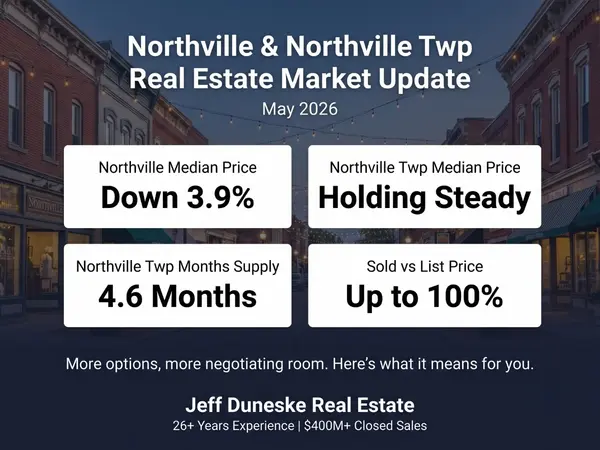
The Northville market remains one of the most consistent in Metro Detroit. The average Northville home value is approximately $571,744 in early 2026, up 6.5 percent year over year, with homes going to pending in about 12 days according to Zillow data. The downtown walkability premium and Northville Public Schools continue to support strong demand. Inventory has loosened modestly but remains tight relative to demand for well-prepared homes. Recent sales data from Northville show homes selling at or above list price within days when priced correctly — a $429,000 sale on Butler Street closed at 2 percent above list in 4 days in February 2026.
Novi
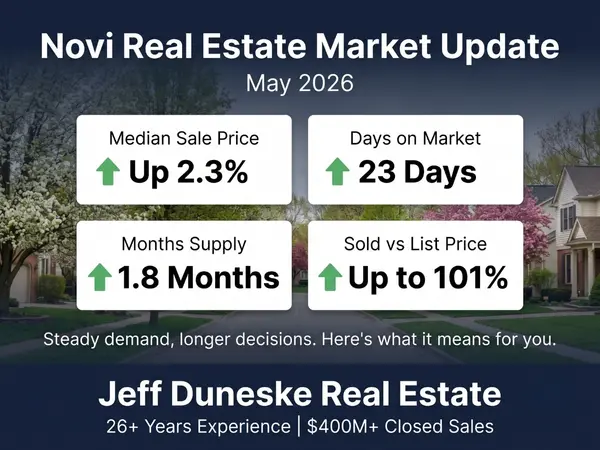
Novi continues to command a premium driven by Novi Community Schools and a strong commercial base. Inventory has improved year over year but remains competitive in the most desirable subdivisions. Buyers in this market are typically corporate relocations, professional households, and move-up buyers from neighboring communities — a buyer profile that requires polished marketing and accurate pricing.
South Lyon
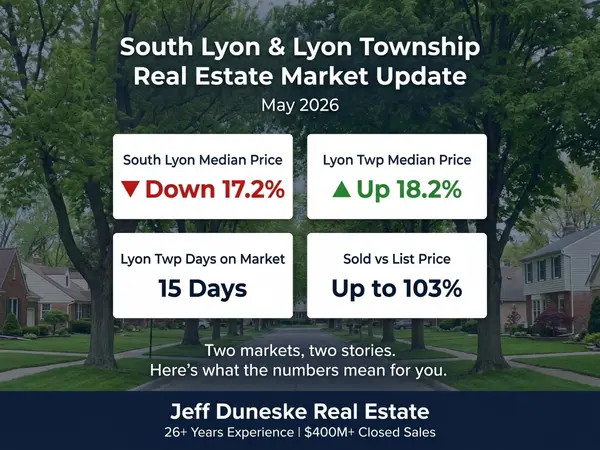
South Lyon has appreciated 4 to 5 percent year over year, with the average home value sitting around $453,980 in early 2026. The market is one of the most affordable options in western Oakland County while still offering the South Lyon Community Schools district. South Lyon homes typically run 10 to 15 percent below comparable Northville and Novi properties, which has expanded the buyer pool to include first-time homeowners, families priced out of neighboring communities, and downsizers seeking the school district at a lower price point.
Plymouth
Plymouth's median sale price runs in the $500,000 to $540,000 range, with the city of Plymouth commanding a premium over Plymouth Township for downtown walkability. The market is driven by Plymouth-Canton Community Schools, the Kellogg Park downtown anchor, and a real estate stock that ranges from Victorian classics near downtown to newer construction in the township. Plymouth's competitive market typically sees homes pending within 25 days, with downtown-adjacent properties moving fastest.
What Sellers Should Do Before Listing — Five Practical Decisions
Five decisions, made before a sign goes in the yard, separate the listings that perform well in 2026 from the listings that disappoint.
Get an Accurate Valuation Before You Set an Expectation
Before deciding whether to sell — and certainly before deciding when to list — get a professional valuation grounded in current comparable sales, not a Zestimate. Online valuation tools are useful for ballparks but consistently miss community-specific dynamics, recent sales not yet reflected in their data, and the unique attributes of an individual home. The valuation is the foundation of every other decision.
Address Deferred Maintenance Before Listing, Not at Inspection
Buyers are inspecting carefully in 2026. A roof at the end of its life, an aging HVAC system, a deck with rot, or a basement with water staining will surface either before listing or at inspection — and it costs significantly more when it surfaces at inspection. A pre-listing inspection identifies the issues that will hurt the deal and lets the seller decide which to fix and which to disclose.
Prepare the Home to Show — Not to Live In
The standard for "show-ready" is meaningfully higher than it was a decade ago. Professional photography, decluttering, neutral paint where needed, and basic staging are no longer optional at most price points. Buyers are scrolling through dozens of homes online before they tour. The photos are the listing, and the showing experience either confirms the photos or contradicts them.
Time the Listing to the Market, Not to Your Calendar
The traditional spring market still produces the strongest activity, but timing a listing requires more nuance than "list in April." Local micro-markets matter. A seller in Northville Hills Golf Club faces a different competitive dynamic than a seller in Highland Lakes, even within the same city. Timing should be informed by the inventory and absorption rate of your specific neighborhood, not the regional average.
Choose an Agent Who Will Tell You What Is True, Not What You Want to Hear
The single most consequential factor in a successful 2026 sale is the agent. Specifically: an agent who will price the home accurately even when the seller wants a higher number, who will recommend pre-listing improvements even when the seller would prefer to skip them, and who will negotiate on both price and terms rather than chasing offers at any cost. A pleasant agent who tells you what you want to hear costs more in a 2026 market than a direct agent who tells you what is true.
A pleasant agent who tells you what you want to hear costs more in a 2026 market than a direct agent who tells you what is true.
How Jeff Duneske Approaches the 2026 Market
Jeff Duneske has been a licensed Michigan real estate agent since 2000 and has closed more than 1,300 transactions across Northville, Novi, South Lyon, Plymouth, and the surrounding Metro Detroit communities. He ranks in the top 1 percent of Michigan agents and holds the SRES and CDRE designations. His approach is built around a Strategic Pricing Plan that combines comparable sales analysis, current market absorption rates, neighborhood-specific demand patterns, and the specific attributes of the individual home. Approximately 75 percent of his business comes from referrals and repeat clients — the most reliable signal that the work meets the standard sellers expect.
The brand line — No pressure. Just clarity. — describes the actual working dynamic. Many sellers spend weeks or months in the consideration phase before listing, and that timing is treated as part of the process rather than something to push past.
Frequently Asked Questions
Is 2026 a good year to sell a home in Metro Detroit?
For homeowners in Northville, Novi, South Lyon, Plymouth, and similar western Oakland and western Wayne County communities, 2026 is a stable and active market. Inventory has loosened modestly, buyer demand is steady, and homes priced correctly continue to sell quickly. The 2026 market favors well-prepared, well-priced homes and penalizes mispriced or poorly prepared listings more sharply than the markets of 2021 through 2023.
How long are homes taking to sell in Northville, Novi, Plymouth, and South Lyon in 2026?
Northville homes are going to pending in approximately 12 days when priced correctly. Plymouth homes typically pend within about 25 days. Novi and South Lyon homes generally fall in a similar range, with strong variation by neighborhood, price tier, and home condition. Mispriced homes can sit for 60 days or longer before requiring a reduction.
What is the average home price in Northville, Novi, South Lyon, and Plymouth in 2026?
Average values vary by source and methodology, but recent data shows Northville at approximately $571,744, South Lyon at approximately $453,980, and Plymouth in the $500,000 to $540,000 range. Novi commands a premium for its school district and commercial base, with strong variation across subdivisions. These are averages — actual price ranges by community span from condo entry points in the $200,000s to luxury homes well above $1 million.
Should I price my home above market value to leave room for negotiation in 2026?
No. In the current market, pricing above market value typically results in fewer showings, fewer offers, and an eventual sale price below what an accurate initial price would have produced. Buyers have more inventory to choose from than they did a few years ago, and they walk away from mispriced homes rather than negotiating against them. Strategic accurate pricing produces better outcomes than aspirational pricing.
How important is a pre-listing inspection in the 2026 market?
A pre-listing inspection is more valuable in 2026 than it was a few years ago. Buyers are inspecting carefully and negotiating on inspection findings. A pre-listing inspection lets the seller identify issues before they appear in a buyer's report, decide which to fix and which to disclose, and avoid surprise reductions at the negotiation stage.
How do I get a realistic valuation of my Metro Detroit home?
A realistic valuation comes from a professional with direct experience in your specific community, working from current comparable sales rather than algorithmic estimates. Sellers in Northville, Novi, South Lyon, and Plymouth can request a free valuation from Jeff Duneske at duneske.com/evaluation or by calling (248) 939-9393.
Selling in Northville, Novi, South Lyon, or Plymouth? Start With a Conversation.
Whether you are listing this month, exploring the market for next spring, or simply gathering information, the conversation starts with a direct, honest discussion about your situation, your home, and what the current market actually supports. No pressure. Just clarity.
Schedule a consultation at duneske.com/contactus or call (248) 939-9393. A free valuation is available at duneske.com/evaluation.
Categories
- All Blogs (243)
- Best Agent For… Blog Series - Northville, Novi, South Lyon & Metro Detroit (88)
- Buyers (37)
- Community & Local Events (2)
- Divorce Real Estate (12)
- Estate Planning & Strategy (11)
- Golf Course & Luxury Living (5)
- Homeowners (Maintenance & Equity) (3)
- Investors (4)
- Market Conditions (12)
- Market Updates (Metro Detroit / Local) (65)
- Mortgage & Financing (2)
- New Construction (5)
- Northville Real Estate Market Updates (10)
- Novi Real Estate Market Updates (8)
- Pricing & Home Values (7)
- Relocation & Moving (10)
- Rightsizing & Senior Moves (18)
- Sellers (81)
- South Lyon Real Estate Market Updates (8)
- Tips, Guides & How-To (13)
Recent Posts


GET MORE INFORMATION